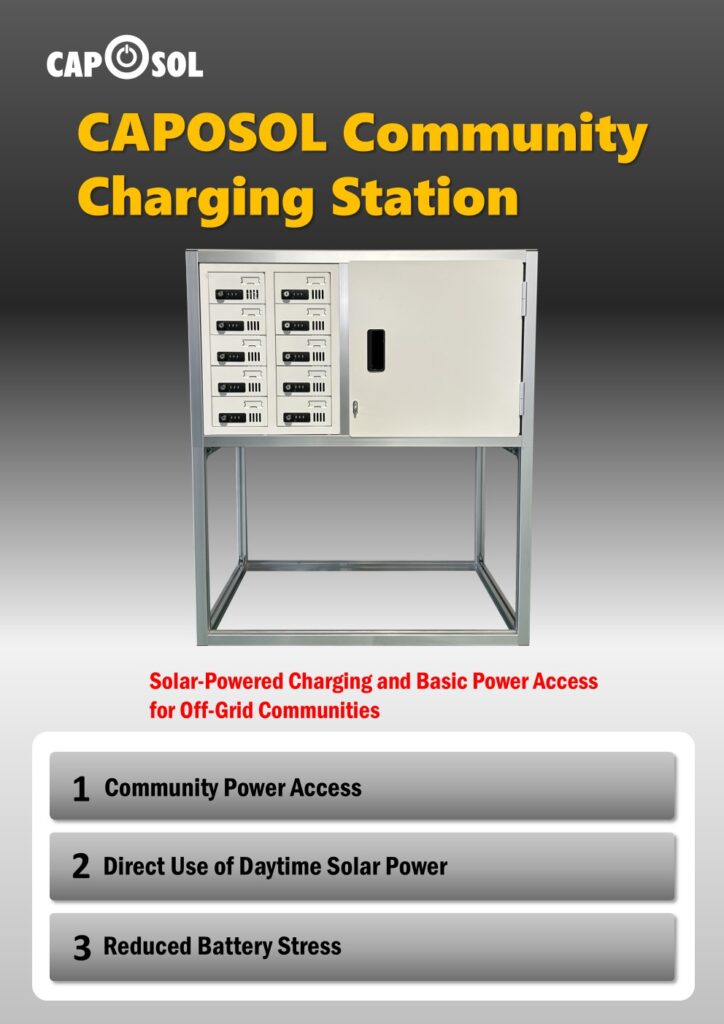
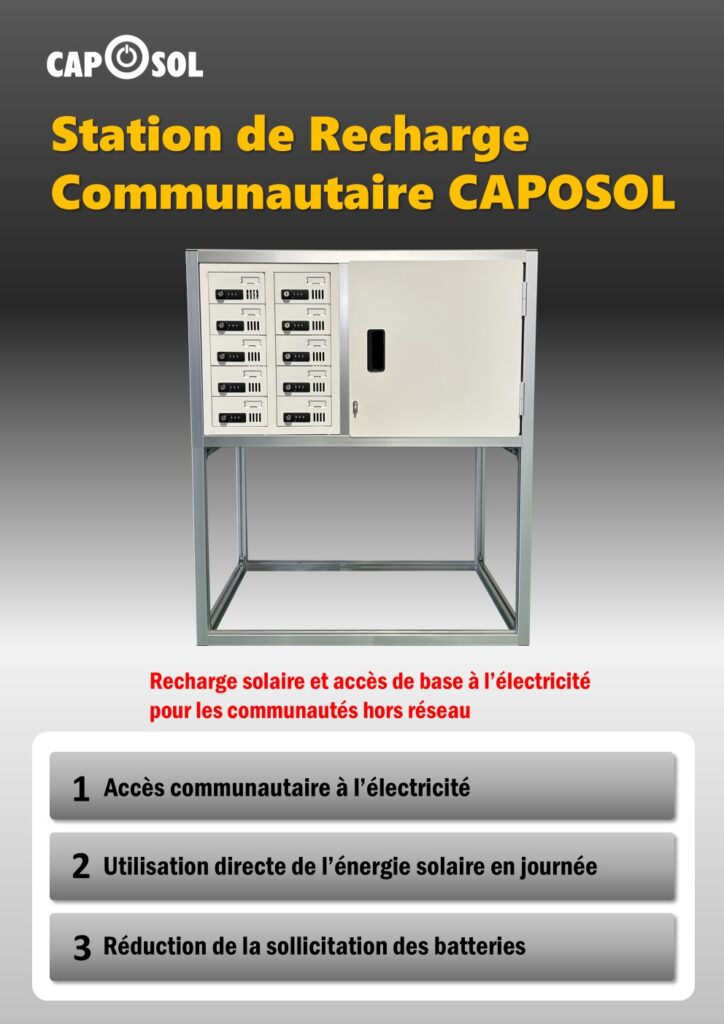
CAPOSOL provides solar-powered charging stations for off-grid communities, schools, and public facilities. The system enables reliable charging of mobile phones and other devices using solar energy, even in areas without grid electricity.
CAPOSOL Community Charging Station
Solar-Powered Charging Station for Off-Grid Communities
CAPOSOL Community Charging Station is a solar power system for areas where grid electricity is limited or not available.
It supports basic power needs, such as charging mobile phones and small electronic devices, and using simple electric equipment inside facilities.
This system is suitable for schools, community facilities, displacement sites, returnee communities, and remote humanitarian service points where stable electricity is difficult to access.
Power Access Challenges in Off-Grid Communities
In many rural areas in Africa, people do not have access to the power grid, or the electricity supply is unstable.
In these areas, basic power access is a serious challenge. People need electricity for mobile phone charging, lighting at night, and the use of small electric devices.
Mobile phones are especially important. They are used for family communication, information access, mobile money, education, and communication with support services.
When people cannot charge their phones, it is not only inconvenient. It can directly affect daily life and community activities.
The Problem of Battery-Dependent Solar Systems
In many rural areas in Africa, solar systems have already been installed in the past. However, many of them are no longer used after the battery reaches the end of its life.
A common off-grid solar system stores electricity in a battery and supplies power from that battery.
For this reason, when the battery reaches the end of its life, the whole system stops, even if the solar panels are still generating electricity.
Battery replacement costs are high. It can also be difficult to find replacement parts or receive repair and maintenance support in rural areas.
This is a major problem for sustainable power access.
Pass-Through Technology to Keep Power Available
CAPOSOL Community Charging Station uses pass-through technology. This technology allows the system to use solar power generated during the daytime directly.
The generated power is first used for charging services and electric devices. Only the remaining power is stored in the battery. When solar power is not enough, the system uses only the necessary power from the battery.
This reduces unnecessary charging and discharging of the battery. As a result, it helps reduce stress on the battery.
Even after the battery reaches the end of its life, the system can continue to operate during the daytime if there is enough sunlight.
The system can also operate during the daytime without a battery connected. This means that even in areas where battery replacement is difficult, daytime power supply can continue.
In areas without grid electricity, if the system stops, people may lose access to phone charging, information, and basic electricity inside facilities.
For this reason, keeping power available as much as possible is very important. It supports daily life, education, communication, and humanitarian support activities.
Lockable Charging Lockers for Safe Charging Services
The standard configuration includes 10 lockable charging lockers.
Each locker has two USB-C charging cables. In total, the standard system provides 20 USB-C charging cables.
Mobile phones contain important personal information, such as contacts, photos, and payment information. Therefore, it is important to charge them in a safe place.
The lockable locker design is suitable for operation in schools and community facilities.
If there are many users, optional USB charging units can be added to support more charging demand.
AC Model and DC Model for Different Uses
CAPOSOL Community Charging Station is available in two models: AC model and DC model.
The AC model includes charging lockers and can also supply power for lighting and small electric devices inside facilities.
It is suitable for schools, offices, community facilities, and other places where basic power use is needed in addition to charging services.
The DC model is mainly designed for charging services in the standard configuration. It does not use an inverter, so the system is simple and efficient for using daytime solar power.
Depending on the required configuration, the DC model can also be used not only for charging services, but also for DC products such as DC freezers.
Because the DC system does not use an inverter, it can reduce conversion loss and use daytime solar power efficiently.
The AC model or DC model can be selected depending on the purpose and required power at the installation site.
For Sustainable Power Access
CAPOSOL Community Charging Station is not only a charging facility. It is a system designed to help maintain power access for a long time in off-grid communities.
By reducing dependence on the battery and using daytime solar power effectively, the system helps continue charging services and basic power use even in areas where battery replacement and maintenance are difficult.
It is suitable for schools, community facilities, displacement sites, returnee communities, remote humanitarian service points, and other places where continuous power supply is needed.
Brochure Download